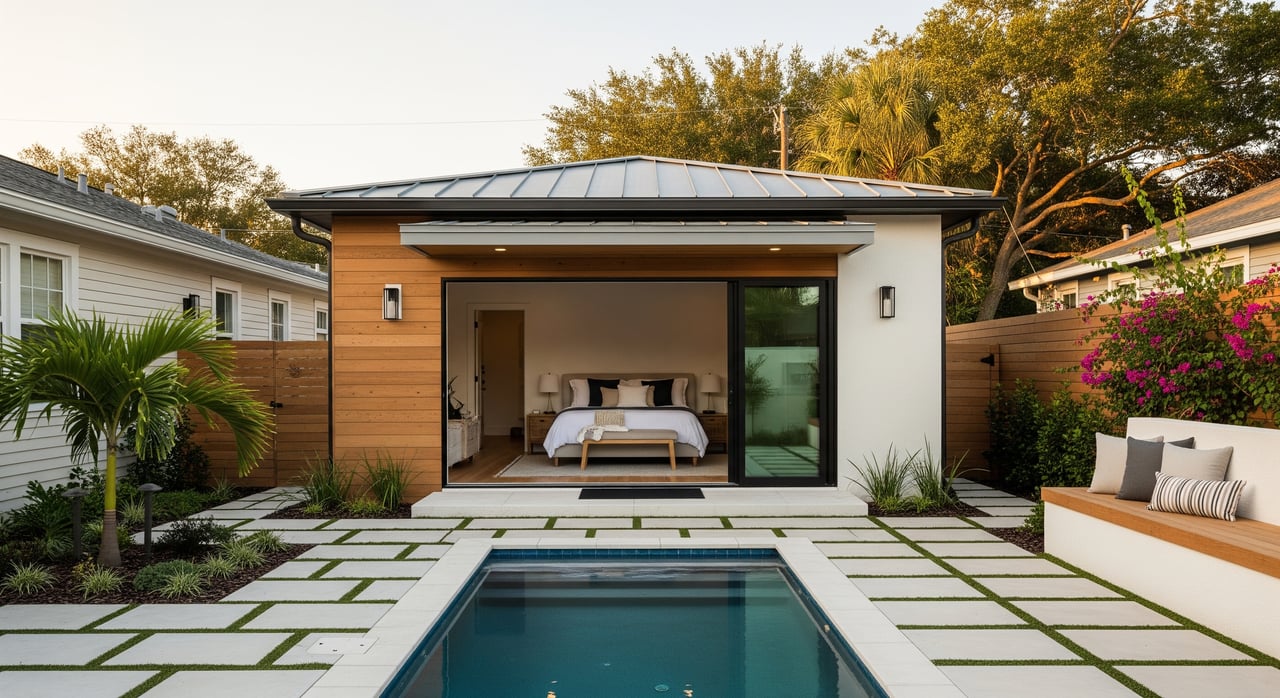
Thinking about offsetting your mortgage by adding a small rental on your property in St. Pete? You are not alone. Accessory dwelling units, or ADUs, are a popular way to house hack, but the rules are specific to your lot and zoning. In this guide, you will learn what counts as an ADU, where they are typically allowed in St. Petersburg, what size and parking standards matter, and how to confirm feasibility before you underwrite any rent. Let’s dive in.
ADU basics in St. Petersburg
An accessory dwelling unit is a secondary, self-contained home on the same lot as a primary single-family house. It can be attached or detached. You might hear terms like accessory apartment or accessory living unit in local documents, but they describe the same idea.
Common ADU types you will encounter:
- Detached cottage or carriage house in the backyard.
- Attached addition or a conversion of part of the main house.
- Garage or accessory structure conversion.
- Junior ADU created within existing space, often smaller with limited kitchen facilities.
A few functional details often drive the rules and your budget:
- Maximum size by square footage or as a percentage of the main home.
- Whether the unit can include a full kitchen and separate utility meters.
- Whether the city requires an owner to live on the property.
- Whether short-term rentals are allowed or restricted.
- Whether the ADU counts toward lot coverage and impervious surface limits.
Zoning and overlay eligibility
Your first step is to confirm that your zoning district permits ADUs. Many Florida cities allow ADUs in single-family districts and sometimes in duplex or multifamily zones with different standards. St. Petersburg follows the same general trend, but permission is district specific.
Overlays can add extra steps or design rules. Historic districts, special planning areas, and neighborhood conservation overlays may require design review or limit placement and height. Parcels in flood zones also face elevation and construction requirements that can affect cost.
Private restrictions still apply. Homeowners associations and recorded covenants can prohibit accessory units even if the city allows them, so always review those documents.
Size and height limits to verify
Most cities set ADU size caps to keep neighborhood scale and protect infrastructure. Typical maximums range from 600 to 1,200 square feet, or a percentage of the main dwelling, often between 30 and 50 percent. Junior ADUs are typically smaller, commonly in the 300 to 500 square foot range. Confirm the exact St. Petersburg cap before you budget rent and construction.
Detached ADUs often have lower height limits than the main house. Typical maximums run 12 to 25 feet, depending on whether the structure is one or two stories and how the code defines height. Setbacks for detached ADUs can be reduced at side and rear yards, commonly in the 3 to 10 foot range, but you still need to maintain minimum separation from the primary structure and property lines.
Conversions inside existing space usually face fewer dimensional barriers than new stand-alone units. If your lot already pushes the limits on coverage or setbacks, a conversion can be a practical path.
Lot coverage and impervious surface
In coastal Pinellas County, stormwater and impervious surface limits matter. If your property is close to the maximum coverage, adding a new building pad or driveway for a detached ADU may trigger redesign. You may need solutions like permeable pavers or additional landscaping to meet drainage rules.
These caps affect footprint and parking, so you do not want to design around a detached unit only to learn the site cannot absorb more impervious area. Verify lot coverage and floor area ratio early.
Parking rules to check
Parking can be the deciding factor for an ADU. Some jurisdictions require one additional off-street space for an accessory unit. Others reduce or waive that requirement in urban or transit-friendly areas. On-street spaces, tandem spaces, or compact spaces may count under certain conditions.
For St. Petersburg, confirm if an extra off-street space is required for your zoning district or if there is an exemption or credit. If your parcel cannot fit the required space without breaking setbacks or coverage limits, the project may not pencil.
Utilities and building code
Most ADUs connect to the same water and sewer as the main house, though rules on separate meters vary by provider. If a property uses septic, the health department must review capacity and may require a system upgrade.
Your plans must meet the Florida Building Code, including hurricane and wind requirements. That drives structural design, openings, and inspections. Plan review typically checks structural, electrical, plumbing, mechanical, and life-safety items.
Recent ADU policy shifts
Across the country and in many Florida communities, cities have expanded ADU options to support housing supply. Common changes include allowing ADUs by right in more residential districts, increasing size limits, and relaxing parking rules.
St. Petersburg has followed elements of this pattern in recent code updates, which means more parcels may be eligible today than a few years ago. To confirm if the rules on your block changed, review the City’s Land Development Regulations and recent ordinance amendments or ask planning staff.
Step-by-step due diligence checklist
Use this quick process before you buy a property for an ADU or list a home that you plan to market as ADU-ready.
- Identify zoning and overlays
- Pull the parcel’s zoning on the City of St. Petersburg GIS. Check overlays for historic districts, special planning areas, and flood zones.
- Find the ADU code section
- Look up the City’s Land Development Regulations for Accessory Dwelling Units or similar terms like accessory living unit or accessory apartment.
- Confirm dimensional standards
- Verify maximum unit size, height, setback and separation, lot coverage, floor area ratio, and impervious surface thresholds.
- Verify parking and access
- Confirm the required number of off-street spaces, whether tandem or on-street credit is allowed, and any exemptions near transit.
- Check non-zoning constraints
- Confirm FEMA flood zone and base flood elevation, historic status, septic versus sewer, utility capacity, and whether separate meters are allowed.
- Get a site-specific answer
- Contact city planning staff for a pre-application meeting or request a zoning verification letter. Ask about detached, attached conversion, and junior ADU options and whether any variances or design review will be needed.
- Budget time and costs
- Outline permit fees, plan design costs, utility connection fees, possible impact fees, and a timeline for plan review and inspections.
Underwriting your ADU house hack
An ADU can help with monthly cash flow, but underwrite like a lender.
- Market rent and vacancy: Study comparable small-unit rents in the immediate area. Focus on long-term rental demand, since short-term rental rules can differ by use and location.
- Operating costs: Factor in extra utilities, maintenance, insurance, property taxes, and potential HOA dues. Ask the Pinellas County Property Appraiser how an ADU could affect assessed value.
- Financing: Many lenders have specific rules for counting ADU income and owner-occupancy. Confirm those terms before you buy or build.
- Capital costs: Compare a detached build to a conversion. Local contractor quotes can vary based on flood elevation, wind load, and site access.
Keep your pro forma conservative until the city confirms the path and you have real bids in hand.
St. Pete constraints to plan for
- Flood elevation: Many St. Petersburg lots sit in FEMA flood zones. Elevating a detached unit, stairs, and compliant foundations add cost and complexity.
- Narrow lots and corner sites: Placement, setbacks, and access for construction can limit where a detached ADU fits.
- Impervious surface and drainage: New roof area and driveways can push you over stormwater limits. Plan for permeable materials or design changes.
- Insurance: Adding a unit in a flood-prone area can change premiums. Get quotes early from carriers that write in Pinellas County.
- Private restrictions: HOA and deed restrictions can prohibit accessory units. Always obtain and read CCRs before you rely on ADU income.
Next steps and local help
If an ADU is part of your move or sale plan, start with zoning confirmation and a quick conversation with planning staff. From there, you can align design options with coverage, height, and parking rules and build a realistic budget and timeline.
If you want a parcel-level screen as you shop or you are weighing how an ADU could impact a future sale, we are here to help. The Diaz Group can coordinate due diligence with your search, flag flood and coverage constraints early, and guide you through a purchase or listing strategy that matches your goals. Get your free home valuation and marketing plan, and let’s talk about the smartest way to house hack in St. Pete.
FAQs
Can I add an ADU to any single-family lot in St. Petersburg?
- Not always. Eligibility depends on your zoning district, overlays like historic areas, setbacks and coverage limits, flood zone status, and utilities. Confirm with the City for a site-specific answer.
What size ADU can I build in St. Pete?
- Many cities cap ADUs between 600 and 1,200 square feet or a percentage of the main home. Junior ADUs are often smaller. Verify St. Petersburg’s exact maximum before you design.
Will I need an extra parking space for an ADU?
- Possibly. Some places require one off-street space per ADU while others allow reductions or on-street credit. Check the current St. Petersburg requirement for your zoning district.
Can I use an ADU for short-term rentals like Airbnb?
- It depends on city rules and licensing. Some areas limit short-term rentals in accessory units. Review St. Petersburg’s short-term rental regulations before you assume nightly income.
How will an ADU affect my property taxes in Pinellas County?
- Adding a dwelling typically increases assessed value, which can raise property taxes. Contact the Pinellas County Property Appraiser to understand how ADUs are assessed.
How long does it take to permit and build an ADU?
- Projects allowed by right can move through plan review in weeks to a few months. If you need variances or historic review, expect several months. Construction time varies by scope and site conditions.